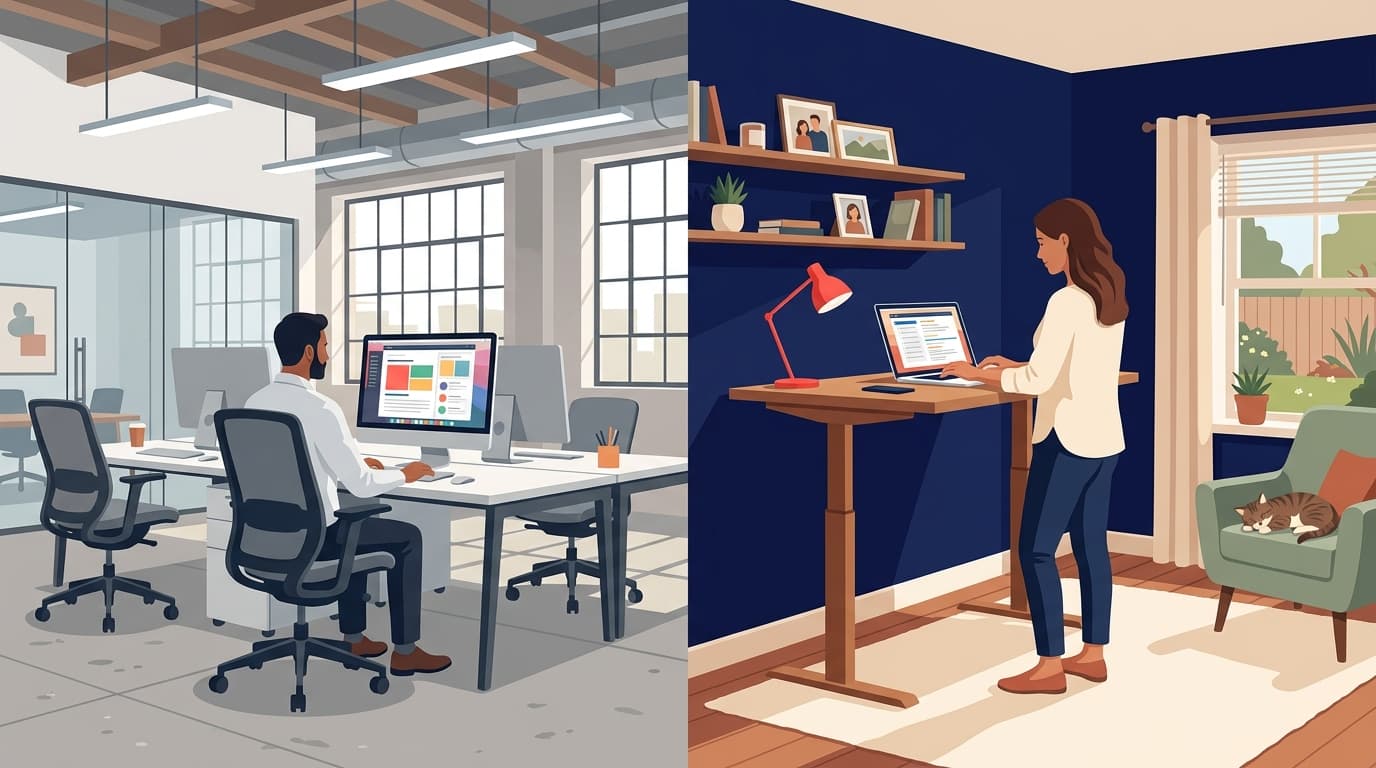
Not all remote work is created equal.
A company that calls itself "remote-friendly" might mean employees can work from home on Fridays. Another might mean it has no offices at all and its 500 employees are spread across 40 countries. Both would show up in the same "Remote" filter on most job boards.
That ambiguity costs people time, energy, and career satisfaction. Job seekers apply to roles that sound remote, only to discover during onboarding that "remote" means "three days in the office and two at home." Companies lose candidates who wanted something different than what was actually on offer.
Remotivated's Work Model classification system exists to fix this. It's a five-tier framework that describes how a company actually operates—not just what it puts in a job listing, but how its culture, processes, and expectations are structured around location.
Why Work Models Matter
Most job boards classify positions as "Remote," "Hybrid," or "On-site." That tells you about the job. It tells you nothing about the company.
Here's why that distinction matters.
A remote job at a fully remote company means your manager is remote, your team is remote, your tools are built for asynchronous communication, and nobody questions why you weren't in the office on Tuesday. The entire operating system is designed for distributed work.
A remote job at an onsite company means you might be the only person not in the room during meetings. Decisions happen in hallway conversations you'll never be part of. Promotions go to the people leadership sees every day. The job is remote. The culture isn't.
Same job title. Same "Remote" label. Completely different experience.
This is exactly the problem Remotivated's Work Model framework solves. Every company on our platform is classified into one of five models, giving you real context before you apply.
The Five Work Models
Remotivated classifies every company into one of five Work Models based on how they structure work around location. These aren't self-reported marketing labels—they're assessed based on company policies, careers page language, job listing patterns, and verified data.
1. Fully Remote
What it means: No offices, or no expectation of office attendance. All employees work remotely.
Fully Remote companies were either founded without offices or have permanently moved to a distributed model. Hiring is location-agnostic (within legal and timezone constraints). There is no headquarters to commute to, no "optional" office that quietly becomes mandatory, and no second-class experience for people who aren't physically present—because nobody is.
What this looks like in practice:
- Company website says "All-remote," "Fully distributed," or "100% remote"
- No headquarters address listed, or headquarters is listed as a legal/registered address only
- Careers page doesn't reference office locations
- All-hands meetings are virtual by default
- Async communication tools (Notion, Loom, Slack) are core infrastructure, not afterthoughts
What it means for job seekers: This is the gold standard for remote workers. Culture, tooling, and processes are all built for distributed work. You won't be fighting an office-centric system—the system was designed for you.
2. Remote-First
What it means: Remote is the default. Offices may exist, but they're optional. Roles that can be performed remotely are remote by default.
Remote-First companies may have physical spaces—a small headquarters, co-working memberships, or regional hubs—but these exist for collaboration, not obligation. The key distinction from Fully Remote is that some inherently onsite roles may exist within the organization. The vast majority of roles, especially knowledge work, are remote by default.
What this looks like in practice:
- "Remote-first" explicitly stated on careers page
- Offices described as "optional," "drop-in," or "collaboration spaces"
- Async communication is the default, not the exception
- Documentation is written for a distributed audience
- Remote is never treated as a perk—it's the operating model
What it means for job seekers: Excellent for remote workers. The culture is built for distributed teams. You might occasionally see an office mentioned, but it won't define your experience.
3. Flexible Hybrid
What it means: Offices are provided, but attendance is voluntary or limited to roughly one day per week. Employees choose their schedule.
Flexible Hybrid companies offer genuine flexibility. They have offices but don't mandate attendance on specific days. The culture is results-oriented rather than location-dependent.
What this looks like in practice:
- Offices exist and may be well-resourced
- No mandatory in-office days, or at most one day per week
- Teams have autonomy over their own schedules
- "Flexible" or "choose your own schedule" language on careers page
- Remote workers are not treated differently in meetings, promotions, or culture
What it means for job seekers: A strong option if you want the option of an office without the obligation. The key question to ask: "What percentage of my team actually comes in, and will I be at a disadvantage if I don't?"
4. Structured Hybrid
What it means: The company mandates specific days in the office—typically two to three days per week. Schedules, meetings, and team rituals are organized around office days.
Structured Hybrid companies have made a deliberate decision about when people should be in person. Employees are generally expected to live within commuting distance of an office. The in-office days aren't suggestions—they're policy.
What this looks like in practice:
- Specific days stated: "Tuesday through Thursday in-office" or "3 days per week minimum"
- Job descriptions reference office proximity
- Culture events and collaboration sessions clustered on in-office days
- "Hybrid" without the "flexible" qualifier
What it means for job seekers: Be honest about whether this model fits your life. If a job at a Structured Hybrid company is listed as "Remote," ask directly: Why is this role remote when most of the company isn't? The answer will tell you a lot about how supported you'll actually be.
5. Onsite
What it means: The office is the default. Remote flexibility may be offered selectively, but it's not the norm.
Onsite companies operate on the assumption that work happens in a physical location. Remote work, where it exists, is an exception granted to specific individuals or roles—not a company-wide philosophy.
What this looks like in practice:
- Job descriptions say "On-site in [City]" or "In-person role"
- Careers page emphasizes office culture or physical workspace
- No remote work policy visible, or described as "case-by-case"
- Hiring is location-specific
What it means for job seekers: If you see a remote job at an Onsite company, proceed with caution—and with questions. Remotivated labels these jobs clearly—"Remote at Onsite Company"—so you always know the context.
How Work Models Connect to the REMOTE Score
Remotivated's REMOTE Score evaluates companies across six dimensions: Retention, Engagement, Morale, Onboarding, Technology, and Equity. A company's Work Model directly influences its REMOTE Score in two ways.
First, the Work Model is a standalone scoring factor. It accounts for a significant portion of the overall REMOTE Score, reflecting the reality that how a company structures work around location is itself a measure of remote culture quality. Fully Remote companies receive the highest score contribution; Onsite companies receive the lowest.
Second, the Work Model modifies each of the six component scores. Fully Remote and Remote-First companies receive small bonuses in dimensions like Engagement, Morale, Onboarding, and Equity—because companies that commit to distributed work tend to invest more intentionally in these areas.
This isn't a penalty for having offices. It's an acknowledgment that building great remote culture requires deliberate effort—and companies that have made that commitment tend to score higher across every dimension that matters to distributed teams.
Learn how the REMOTE Score is calculated
How We Classify Companies
Work Model classifications aren't based on what companies say about themselves in marketing copy. They're assessed using multiple data sources:
- Careers page analysis—What does the company's own hiring content say about location requirements and remote work policies?
- Job listing patterns—What percentage of a company's jobs are listed as remote, hybrid, or onsite?
- Company metadata—Does the company have a physical headquarters? What do employee reviews say about remote culture?
- Verified data—Companies pursuing Remotivated certification self-classify during the process, which is then verified against observable data.
Classifications are reviewed periodically and updated when companies make significant policy changes.
For Job Seekers: Using Work Models in Your Search
Filter by Work Model, not just job type. Remotivated lets you filter by both the job's location type (Remote, Hybrid, Onsite) and the company's Work Model. Search for "Remote jobs at Fully Remote companies" for the highest-confidence match.
Read the combined label. Every job on Remotivated displays a combined label like "Remote at Remote-First Company" or "Hybrid at Structured Hybrid Company." This tells you the full story at a glance.
Ask better interview questions. If you're interviewing at a Flexible Hybrid company for a remote role, you now know the right questions: How many people on this team work remotely? Are remote employees included in promotion decisions equally?
Know your own priorities. Some people thrive in Fully Remote environments. Others prefer the option of an office. There's no wrong answer—but there are wrong matches. Work Models help you find the right one.
For Companies: What Your Work Model Says About You
Your Work Model classification isn't a grade. It's a description.
There's nothing inherently wrong with being a Structured Hybrid company—if that's genuinely how you operate and you're transparent about it. What erodes trust is calling yourself "remote-friendly" when you require three days a week in the office. That's not remote-friendly. That's hybrid with a marketing problem.
If you want to improve your Work Model:
- Moving from Structured Hybrid to Flexible Hybrid means removing mandatory office days and trusting teams to decide for themselves.
- Moving from Flexible Hybrid to Remote-First means making remote the default and restructuring communication, tooling, and culture around distributed work.
- Moving from Remote-First to Fully Remote means committing fully: no office expectations, location-agnostic hiring, and processes designed for asynchronous collaboration.
Each step requires real operational change, not just a policy update. But companies that make the shift tend to see it reflected in their REMOTE Score—and in the quality of candidates they attract.
Explore companies by Work Model
The Bigger Picture
The way companies describe their approach to location has been broken for years. "Remote" means something different to every employer. "Hybrid" is so vague it's almost meaningless.
Remotivated's Work Model framework replaces ambiguity with clarity. Five categories. Clear definitions. Observable criteria. No marketing spin.
Because the first step to finding work that works for you is knowing what you're actually looking at.
Start Exploring
Browse Remote Jobs | Explore Top Companies | Learn About the REMOTE Score